login_title

FOLLOW US

Ukrainian art & cultureOnline

button separator
CreatorsStylesDada

Creators in style

Dada

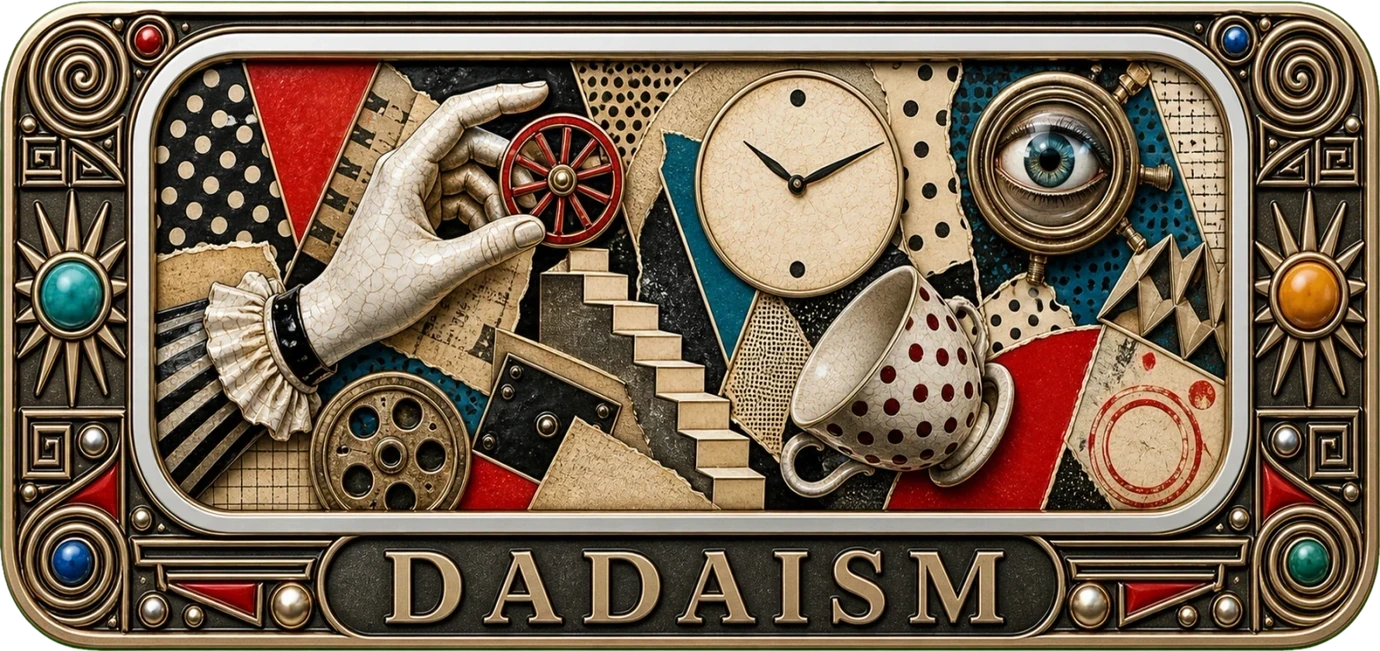
Dada was a radical anti-art movement born in 1916 in Zurich, at the Cabaret Voltaire, as an outraged response to the carnage of the First World War and to the bourgeois rationalism that had produced it. At the core of the Dada aesthetic lay deliberate provocation: the rejection of logic, taste and the very notion of the masterpiece, and a cult of chance, absurdity and irony. The movement's formal arsenal was exceptionally heterogeneous — photomontage, collage, assemblage, the readymade (a ready-made industrial object elevated to the status of an artwork), and sound or phonetic poetry. Composition was governed by rupture, by the collision of irreconcilable fragments and the montage of clippings from newspapers and advertising. Marcel Duchamp, with his urinal "Fountain" (1917) and his defaced "Mona Lisa," undermined the institution of the museum itself; Kurt Schwitters devised his own "Merz" system out of rubbish and tram tickets; Hannah Höch and Raoul Hausmann in Berlin turned photomontage into a political weapon; Man Ray and Francis Picabia extended the field toward machine-like imagery. Tristan Tzara formulated the movement's manifestos and its technique of poems assembled from cut-up words. Dada was fundamentally international and short-lived, yet it opened the road to Surrealism, conceptualism and all later art of the object and the action. Its legacy is not a style in the narrow sense but a new strategy: art as a critical gesture that questions its own limits.

Read more
Dada logo

Who works in the style “Dada”
Showing 0 of 0

Play-100

Page in development

Artists of this section will appear here as soon as they are added.

Saved — sign in required

Other dimensions of culture

The whole Play Ukraine ecosystem

  • Fashion
  • Music
  • Cuisine
  • Literature
  • Play Ukraine — The whole ecosystem

Test mode: all content on this site is for testing and will be removed at launch.