Ukrainian art & cultureOnline


Other dimensions of culture
Other dimensions of culture





Test mode: all content on this site is for testing and will be removed at launch.
Art Glossary
Ukrainian Art&Culture online glossary of art terms covers movements, styles and techniques such as Impressionism, Printmaking, Video art and more.
from Realismto Cyberpunk
34from Oilto 3D Modeling
8from Paintingto Design
7from Trypilliato Contemporary
2314 terms

Figurative art is any form of modern art that retains distinct, recognisable references to the real world, and above all to the human figure. The term acquired particular meaning in the twentieth century as the opposite of abstract art: whereas abstraction rejects the depiction of recognisable objects, figurative art deliberately maintains a link with visible reality. Importantly, figurative does not mean simple copying of nature—it can be highly stylised, distorted or expressive, as long as figures, faces or objects remain recognisable within it. After the mid-twentieth-century dominance of abstraction there was a powerful return to figuration, represented among others by the expressive, disquieting canvases of Francis Bacon, the monumental fleshly images of Lucian Freud and the School of London, and various currents of Neo-Expressionism and new realism. The human figure remains one of the oldest and most enduring subjects of art, from prehistoric cave images to the present day. Figurative art testifies to the persistent need of artists to reflect on the human being, the body and the surrounding world, developing alongside abstraction rather than in denial of its existence.

Folk art is a collective form of creativity that grows out of traditional life, ritual and craft, is handed down from generation to generation and requires no academic training. Its aesthetic rests not on individual innovation but on a canon: established types of ornament, colour combinations and symbols that the maker varies within a shared tradition. Its characteristic features are flatness, decorative stylization, the rhythmic construction of pattern, bright local colour, symmetry, and a sacred symbolism of fertility, goodness and protection. Folk art is inseparable from utilitarian function: it lives in ceramics, weaving, embroidery, carving, the painting of chests and stoves, and icons on glass. In Ukraine its richness is exceptional — Petrykivka painting with its flowering branches, Opishnia and Kosiv ceramics, paper-cut vytynanka, the pysanka, and Poltava and Borshchiv embroidery. A separate chapter belongs to the naïve painting of self-taught masters: Maria Prymachenko with her fabulous beasts and flowers, Kateryna Bilokur with her hyperbolically lavish bouquets, and Nikifor Drovniak of Krynica. These artists, without professional education, created self-sufficient worlds of exceptional plastic power. Folk art is marked by sincerity of feeling, an organic bond with the natural cycle and a deep symbolic density. Each region cultivated its own recognizable manner — its colouring, repertoire of motifs and technique — by which a connoisseur can unerringly tell where an object came from. Here ornament is never mere decoration: it carries a protective, calendrical and ancestral semantics encoded in signs of the sun, the tree of life, the field-rhombus and the bird. Passed from master to apprentice and from mother to daughter, this tradition secured the continuity of collective memory and of an aesthetic canon over the centuries. It became a nourishing source for the professional avant-garde and for design, and it remains the foundation of national visual identity — proof that great art can be born beyond the walls of the academy.
Formalism is an approach to the study and evaluation of art based solely on the analysis of its form—that is, the way a work is made and how it looks: composition, line, colour, texture, space and the relationship of parts. For a formalist, the artistic value of a work lies in its visual, formal qualities rather than in subject matter, narrative, historical context or social message. Formalism played a major role in the formation of modernist criticism and in the theoretical justification of abstract art, since formal analysis makes it possible to discuss works that lack recognisable imagery. Significant contributions to formalist thinking were made by the British critics Roger Fry and Clive Bell, who proposed the notion of significant form. In the mid-twentieth century the most influential advocate of formalism was the American critic Clement Greenberg, who championed the idea of the purity of each art form and interpreted the history of modernism as the progressive purification of painting toward its purely optical, flat properties. Formalism was later sharply criticised by contextual and social approaches, yet it remains a basic tool for describing and analysing the visual language of art.
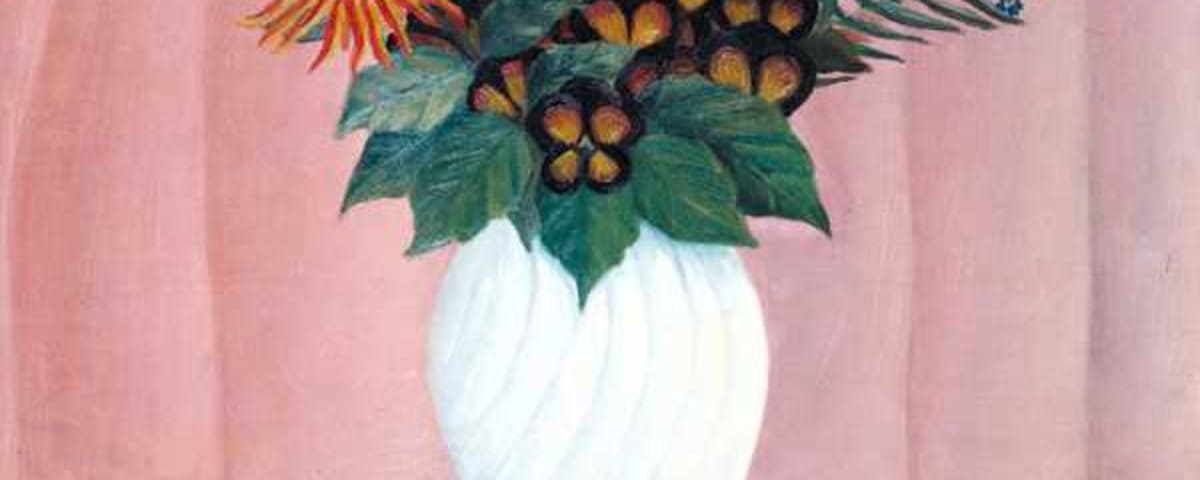
Naive art is the visual language of self-taught makers who create outside the academic tradition, relying on a direct feeling for the world rather than learned rules. Its core is a sincerity of vision in which naivety becomes not a fault but an aesthetic virtue. Formally, such works are marked by flattened space and a deliberate disregard for linear perspective and anatomical proportion. The palette is usually bright, local and decorative, without tonal gradation or academic chiaroscuro modelling. Composition tends toward symmetry, ornament and an even filling of the surface, where every detail is rendered with equal attention. Motifs are drawn from folklore, everyday life, religious subjects, and flora and fauna, often fantastical. The technique may be intentionally simplified, yet it astonishes with confident line and bold colour. In the international context the movement's classic figure is the Frenchman Henri Rousseau (the Douanier), with his fairy-tale jungles. In Ukrainian art the naive impulse reached world stature in the work of Maria Prymachenko, with her fantastical beasts and flowers. The circle of masters also includes the Lemko Nikifor Krynytsky (Epifaniy Drovniak), a singular watercolour chronicler of the provinces. Naive art is closely akin to primitivism and folk painting, yet it preserves an inimitable authorial voice. It influenced the avant-garde, which sought in it a pristine freshness. Today the movement is prized for its authenticity, decorative power and capacity to renew the very idea of artistic truth.

New Sculpture is a term denoting a tendency in British sculpture of the second half of the nineteenth century, roughly from the 1880s to the early 1900s. It emerged as a reaction against the frozen neoclassicism and static quality of earlier Victorian sculpture. New Sculpture artists sought greater naturalism, psychological expressiveness, poetry, and symbolic content, drawing at the same time on the influence of the French school and the Italian Renaissance. They paid particular attention to surface, movement, detail, and subtle modeling, often combining different materials — bronze, ivory, colored enamels, and precious stones. Leading figures of the tendency include Frederic Leighton, author of the landmark "An Athlete Wrestling with a Python," Alfred Gilbert, Hamo Thornycroft, and Alfred Drury. New Sculpture also promoted the development of the decorative statuette and closely echoed the Arts and Crafts movement and Art Nouveau. It substantially renewed British sculpture and prepared the ground for the modernist sculpture of the twentieth century.