




Art terms on "W"

War artists
War artists are artists who record war through art — from official state commissioning schemes (Britain established one in 1916 and revived it in 1939) to independent practice by artists working inside their own country while the fighting continues. In Ukraine the role became widespread after 2014 and especially after the full-scale invasion of 2022: artists document, testify and raise funds for the defence, and some of them serve.
Read more →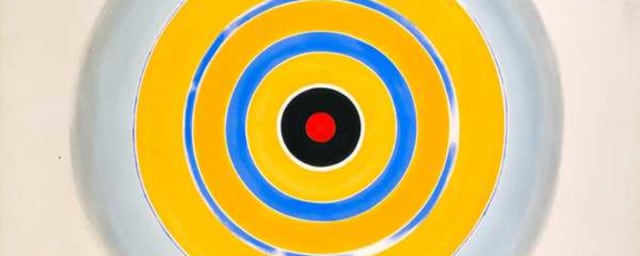
Washington Color School
The Washington Color School was an art movement that emerged in the late 1950s and early 1960s in Washington, D.C., developing an abstract art based on colour. Its key figures were Morris Louis and Kenneth Noland, along with Gene Davis, Howard Mehring, Thomas Downing and Paul Reed. The movement grew out of color field painting and was part of the broader tendency of post-painterly abstraction, which the critic Clement Greenberg gave a theoretical foundation. The school's artists abandoned the gestural expression of Abstract Expressionism in favour of the pure, calm, optical impact of colour. An important technical innovation was staining: Louis and Noland applied diluted acrylic paint directly onto unprimed canvas, so that the colour soaked into the fibres of the fabric and became inseparable from the surface, eliminating any sense of the brushstroke. Louis created flowing veils and rivulets of colour in his Veils and Unfurleds series, while Noland worked with concentric target circles and chevrons. The Washington Color School made a significant contribution to the development of American abstraction and to the geometric, optically saturated painting of the 1960s.
Read more →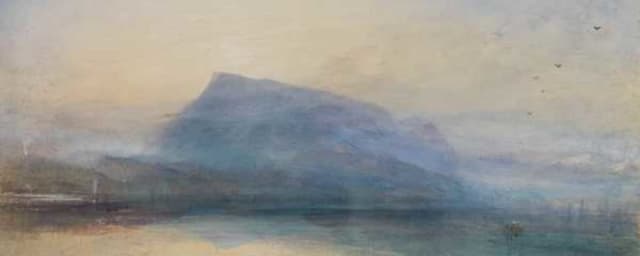
Watercolour
Watercolour is a painting technique, and the works made with it, using water-soluble paints with transparent properties. Pigment is mixed with a binder, usually gum arabic, and thinned with water; light passes through the translucent layers of paint and reflects off the white paper, giving watercolour its characteristic lightness, freshness and luminosity. The classic technique uses no white paint, since the highlights are left as unpainted paper. Watercolour has a long history, appearing in Egyptian manuscripts, medieval miniatures and illuminated books. It reached its height as an independent art in eighteenth- and nineteenth-century Britain, where J. M. W. Turner raised it to the level of major landscape painting. Watercolour remained important for scientific illustration, botanical studies and plein-air sketches thanks to the portability of its materials. In Ukrainian art landscapists and graphic artists worked extensively in watercolour, notably Taras Shevchenko, whose watercolour views and portraits are a valued part of the national heritage. The technique demands confidence and speed, since correcting the transparent layers is extremely difficult.
Read more →
Watermark
Watermark is an image or mark on a sheet of paper, visible when the sheet is viewed against the light. The mark is produced by variation in the thickness of the paper within a single sheet: during handmade papermaking, a thin wire design is attached to the wire mesh mould, and in those places less fibre settles, so the paper becomes slightly thinner and lets through more light. Watermarks appeared in Italian papermaking at the end of the thirteenth century and initially served as the marks of workshops or paper mills. Over time they became important for establishing the origin and dating of paper. For art historians, watermarks are a valuable tool for studying old drawings, prints, and manuscripts: analysis of the mark helps to determine when and where a sheet was made, and thus to refine the attribution and dating of a work. Watermarks are also used as a means of protection against forgery — on banknotes, documents, and postage stamps. In the artistic context, the study of watermarks is part of the technical examination of works on paper.
Read more →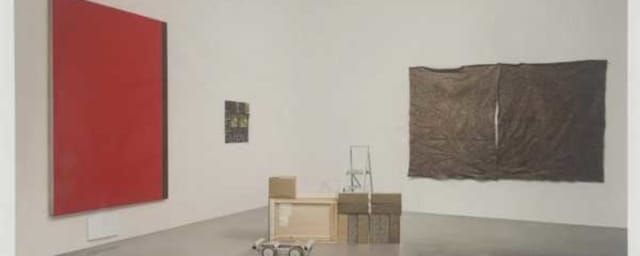
White cube
'White cube' is the established term for the dominant exhibition aesthetic of the twentieth century: a square or elongated space with plain white walls, a smooth floor and usually concealed overhead lighting. The aim of such a space is to remove any distracting elements so that the viewer concentrates solely on the works, which appear as isolated, self-sufficient objects. This 'neutral' shell became so widespread that it is perceived as the natural, almost invisible standard for displaying contemporary art in galleries and museums around the world. The concept itself was critically examined by the Irish artist and theorist Brian O'Doherty in the series of essays 'Inside the White Cube', published in Artforum in 1976. He showed that the white cube is not neutral at all: it carries an ideology, lending works of art an aura of sanctity, timelessness and market value while detaching them from their social and political context. This critique inspired numerous attempts to move beyond the gallery — site-specific art, installation, land art and practices working in public space. Despite all these challenges, the white cube remains the dominant model of display to this day.
Read more →
Woodcut
Woodcut is a method of relief (raised) printing in which the image is cut into the surface of a wooden block sawn along the grain. The artist removes the areas that are to remain white, leaving raised the lines and planes of the intended image; these raised parts are inked and pressed against the paper. Woodcut is the oldest technique for printing images: in East Asia it was used from the early medieval period, and in Europe it spread in the late fourteenth and early fifteenth centuries alongside the manufacture of paper. European woodcut reached its highest artistic level in the work of Albrecht Dürer, whose prints astonish with the fineness of their line and the complexity of their composition. In the twentieth century, the German Expressionists revived the woodcut for its rough, energetic expressiveness. Woodcut should be distinguished from wood engraving, cut across the grain, and from the related linocut. In Ukrainian art, woodcut had a long tradition in the decoration of early printed books, notably in the book engraving of the Baroque era.
Read more →
Wood engraving
Wood engraving is a relief (letterpress) printing technique in which the image is cut into the end grain of a hard wood, most often boxwood, rather than the side or plank grain used in a traditional woodcut. In a woodcut the artist gouges away the background so that the drawn line stands up in relief; in wood engraving the fine tool, or burin, incises the line itself into a smooth, dense surface, and the untouched areas print as solid black. The compact end grain allows the engraver to achieve extremely fine, precise lines and a rich range of tonal values, which made the medium ideal for detailed reproduction in print. The technique was refined and popularised in late eighteenth-century England by Thomas Bewick, whose natural-history illustrations set the standard, and it became the dominant means of book and magazine illustration throughout the nineteenth century. In Ukrainian art, engraving on wood reaches back to the printing houses of the seventeenth century, above all the Kyiv-Pechersk Lavra workshop with masters such as Illya and Nykodym Zubrytsky (alongside the copper engraver Leontii Tarasevych). In the twentieth century a brilliant school of Ukrainian xylography emerged around Vasyl Kasiian, Ivan Padalka and the Boychukist circle, who fused folk tradition with a modern graphic idiom.
Read more →



