




Art terms on "M"
Magic realism
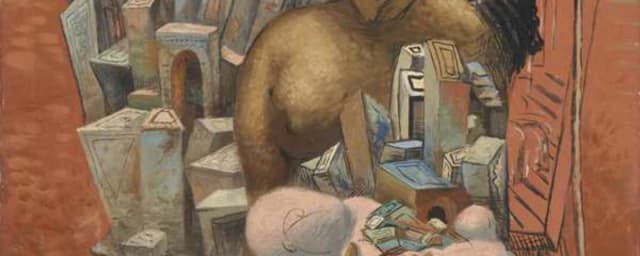
Magic realism is a term coined by the art historian and critic Franz Roh in 1925 to describe a strain of postwar European painting in which the world is depicted with emphatic clarity and realistic precision, yet with a sense of mystery, wonder or dreamlike estrangement. Unlike Surrealism, which released the unconscious and the illogical, magic realism preserves the clear, almost photographic distinctness of objects while endowing the ordinary with an aura of secrecy. Roh linked it to the New Objectivity (Neue Sachlichkeit) tendency in German art. The concept later spread to artists in various countries, including the American scene, and more widely still to literature, where magic realism became defining for Latin American prose. In painting, magic realism is distinguished by sharp detail, stillness, strange juxtapositions of familiar objects and a sense of muffled tension beneath the surface of the everyday. The tendency reflected a wish to return to the figurative after abstract and expressionist experiments, without losing modern anxiety.
Read more →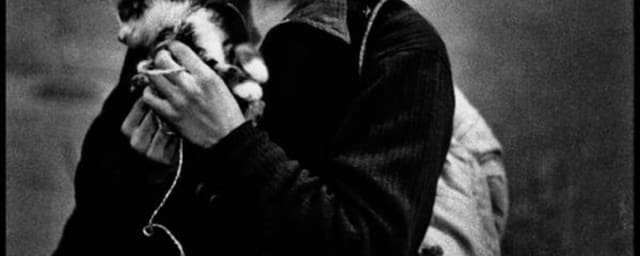
Magnum Photos
Magnum Photos is a photographic cooperative founded in 1947, notably in New York and Paris, with the aim of giving photographers the freedom to record what they judged important without submitting to the editorial agendas of magazines and newspapers. Its founders included Henri Cartier-Bresson, Robert Capa, David "Chim" Seymour and George Rodger, legends of photojournalism who wanted to retain copyright and control over their own images. The cooperative, owned by the photographers themselves, established high standards for independent documentary photography and photojournalism, combining testimony about world events with a distinctive personal vision. Cartier-Bresson articulated the influential idea of the "decisive moment", the instant when form and event coincide in a perfect composition. Over the decades Magnum recorded wars, revolutions, everyday life and culture across all continents, including events in Ukraine. The agency remains a model of ethical, authorial photography and one of the most prestigious institutions in the world of the documentary image.
Read more →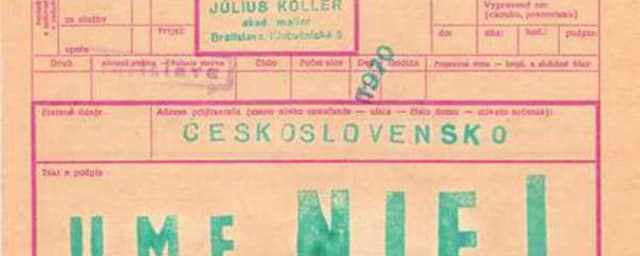
Mail art
Mail art is an art movement founded on the principle of sending small works through the postal service, so that the post becomes both a means of distribution and a part of the work itself. Participants exchange postcards, collages, stamps, drawings, small objects and conceptual messages, forming a global informal network of collaboration beyond galleries, the market and curatorial control. The origins of the movement are associated with the American artist Ray Johnson, who in the late 1950s began the mail exchanges that later became known as the New York Correspondence School. Mail art flourished in the context of Fluxus and the Conceptualism of the 1960s and 1970s, attracting artists with the idea of democratic, accessible and anti-commercial exchange. It played an important role for artists in countries with limited creative freedom, including behind the Iron Curtain, where the post allowed contact with the international community. Mail art stresses process, communication and network rather than the unique precious object, and is regarded as a forerunner of the networked art of the digital age.
Read more →
Mannerist
Mannerism is a style of European art of roughly 1520 to 1600 that arose as a reaction to the harmonious balance of the High Renaissance and is characterised by artifice, refined elegance and a deliberate sensuous distortion of the human figure. The name derives from the Italian maniera ('manner', 'style'). Mannerists elongated the proportions of bodies, gave them unnatural, spiralling poses (figura serpentinata), crowded complex compositions, and employed tense, sometimes artificial colours and packed, congested space. In place of clarity and balance they prized invention, wit and intellectual play addressed to the connoisseur. The leading masters were Pontormo, Rosso Fiorentino, Parmigianino and Agnolo Bronzino, and in sculpture and the decorative arts Benvenuto Cellini and Giambologna. Mannerism reflected the spiritual crisis of the age of Reformation and Counter-Reformation, unsettling Renaissance ideals. Long regarded as decadent, it was reassessed in the twentieth century as a distinctive, sophisticated and psychologically charged artistic language that preceded the Baroque.
Read more →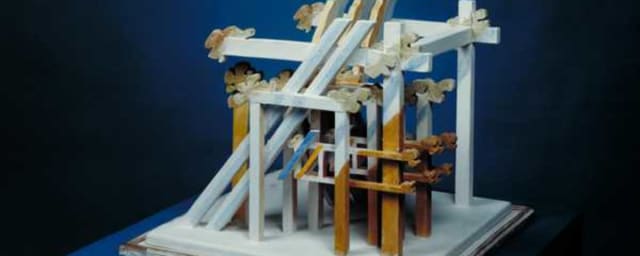
Maquette
A maquette is a preliminary model, usually small in size, for a larger sculptural or architectural work. The word comes from the French maquette (from the Italian macchietta, meaning "little sketch"), and in sculpture it denotes a rough three-dimensional study in which the artist works out the overall composition, proportions, mass and silhouette of the future work before executing it in its final material and scale. A maquette is often modelled in clay, wax, plaster, plasticine or card; it plays the same role as a preparatory drawing in painting. Maquettes are valuable both as a working tool and as independent works of art that preserve the immediacy of the artist's conception. They allow the course of creative thought to be traced, so museums prize them as evidence of process. In monumental sculpture, a maquette is submitted for monument competitions, used to approve a project and then scaled up to full size. Ukrainian sculptors working on monuments and garden sculpture invariably began with maquettes. The term is also used in architecture, stage design and filmmaking for three-dimensional models of buildings and sets.
Read more →Marine painting
A branch of the landscape genre devoted to the sea — sea views, ships and harbours; also an individual work of this kind.
Read more →
Market Photo Workshop
The Market Photo Workshop is an educational and artistic institution founded by the documentary photographer David Goldblatt in 1989 in Johannesburg. It was created initially to support black photographers under apartheid in South Africa, when racial segregation denied most of the population access to artistic education and professional opportunity. The workshop offered practical skills, critical training and a space where photographers could reflect on their own society and document the struggle for dignity and freedom. With the fall of apartheid it grew into one of the leading platforms of South African photography, nurturing a generation of influential authors, among them Zanele Muholi and Jodi Bieber. The Market Photo Workshop combines teaching, exhibition activity and a civic mission, emphasising the role of photography in shaping memory, identity and social justice. Its experience is a vivid example of how art education can be an instrument of emancipation, which resonates with the role of culture in Ukrainian civil society.
Read more →
Matter painting
Matter painting is a technique in which foreign materials — sand, earth, cement, plaster, sawdust, shells, or scraps of fabric — are added to thick impasto paint in order to give the surface a tangible physical texture and weight. Instead of depicting the world, the artist emphasises the very materiality of the work, turning the canvas into an object with its own relief and substance. This practice flourished in European art after the Second World War, within Art Informel and Tachisme of the 1940s and 1950s, as a reaction against geometric abstraction and a striving for immediate, almost organic expressiveness. Leading practitioners of matter painting were Jean Dubuffet, with his «texturologies», and the Spanish artist Antoni Tàpies, who mixed marble dust and sand to create wall-like surfaces bearing traces of scratches and inscriptions. The technique influenced the development of assemblage and blurred the boundary between painting and sculpture, enriching the vocabulary of postwar abstraction.
Read more →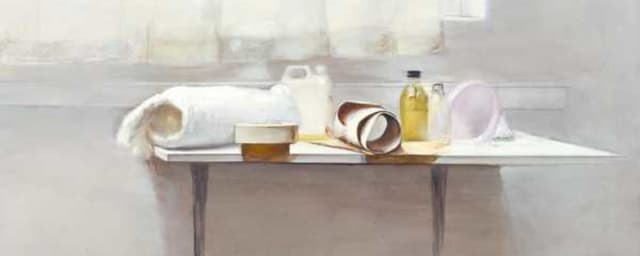
Medium
Medium is a term with a double meaning in art. First, it denotes a type or kind of art, for example painting, sculpture, printmaking, photography, video, or performance. Second, it refers to the specific materials and substances from which a work is made: oil paint, watercolour, bronze, marble, clay, ink, and so on. In painting the word medium also has a narrower technical meaning, namely the liquid, such as oil or gum arabic, used to dilute pigment and give the paint the desired consistency and properties. The choice of medium is fundamental to artistic expression, since each material has its own expressive possibilities, limitations, and cultural associations. Modernist criticism of the twentieth century, especially in the writings of Clement Greenberg, emphasised medium specificity, the idea that each art form should explore its own unique nature, for example painting the flatness of the canvas. In the second half of the twentieth century, however, artists increasingly began to break down the boundaries between media, creating multimedia, hybrid, and intermedial works. The notion of the post-medium condition, proposed by Rosalind Krauss, describes the contemporary situation in which the traditional boundaries between art forms have lost their former rigidity.
Read more →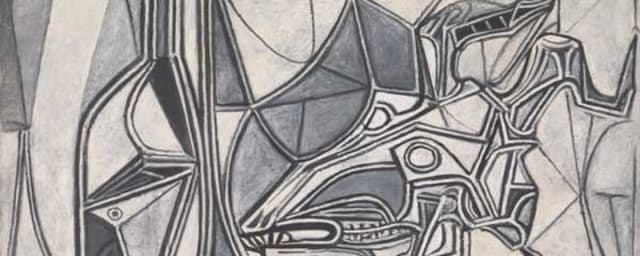
Memento mori
Memento mori (Latin for 'remember that you must die') is a work of art or motif created to remind the viewer of the inevitability of death, the transience of earthly life and the vanity of worldly goods. It is at once a philosophical and a moral admonition, rooted in the classical and Christian traditions: awareness of one's mortality was meant to encourage a person to live honestly, care for the soul and not become attached to the fleeting. In art the idea is embodied through a set of recognizable symbols. The most characteristic symbol of memento mori is the human skull, along with extinguished candles, hourglasses and clocks (the passage of time), wilted flowers, rotting fruit, soap bubbles and bones. These images flourished in European Baroque art, especially in the vanitas still lifes of the seventeenth century, as well as in funerary sculpture, portraits and the religious painting of the Middle Ages and the Renaissance. The motif was often combined with motto inscriptions. Memento mori reflected a deep religiosity and an acute sense of the fragility of life, intensified by plague epidemics and wars. The idea and symbolism of mortality continue to inspire artists in contemporary art, from Damien Hirst to conceptual installations.
Read more →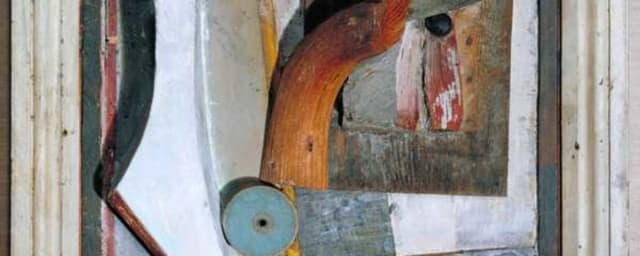
Merz
Merz is an invented nonsense word that the German Dada artist Kurt Schwitters introduced around 1919 to designate his own artistic method: collages and assemblages composed of gathered second-hand materials — tickets, wrappers, scraps of newspaper, buttons, wire, splinters of wood and other urban refuse. The word arose by chance when a fragment of the name of the bank 'Commerz und Privatbank' found its way into one of his collages; the syllable 'merz' survived and gave its name to the whole practice. Schwitters proclaimed Merz a universal worldview capable of embracing any material and any medium — poetry, painting, sculpture, music, print. Its most ambitious embodiment was the 'Merzbau', a durational architectural installation with which the artist rebuilt his own home in Hanover over years, turning it into a branching spatial construction. Merz celebrates the beauty of the devalued, discarded and accidental, raising the waste of consumer society to the status of art. The practice exerted a marked influence on postwar assemblage art, Pop art and the conceptual currents of the twentieth century.
Read more →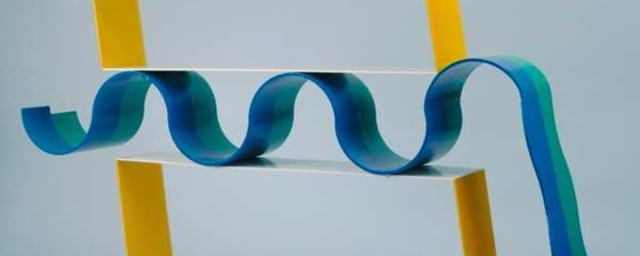
Metal
Metal is a hard, strong and opaque material that has been used by sculptors since the earliest times. Owing to its strength, malleability and ability to hold complex forms, metals allow the creation of both monumental sculpture and delicate jewellery. The most common in art are bronze (an alloy of copper and tin), which is cast in moulds, as well as iron, steel, copper, lead, gold and silver. Metal is worked in various ways — casting, forging, chasing, welding and engraving — each giving its own texture and expressiveness. Bronze casting, known since antiquity and perfected in the Renaissance, remains a classic technique of easel and monumental sculpture. In the twentieth century artists began using welded steel and industrial metals extensively: Julio González and David Smith opened a new language of constructed metal sculpture, and the Minimalists valued the cold precision of industrial surfaces. In Ukraine a rich tradition of artistic metalwork reaches back to Scythian gold and Cossack decorative art, and contemporary sculptors continue to work with forging, casting and welding in both monumental and intimate works.
Read more →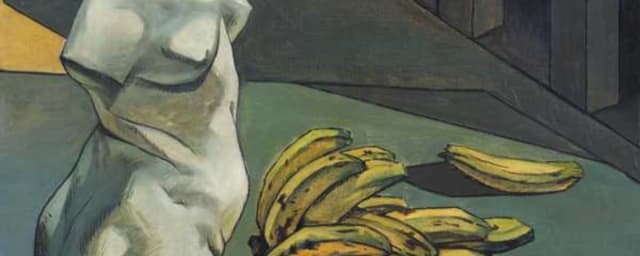
Metaphysical Art
Metaphysical art (Italian Pittura metafisica) is an Italian tendency of the early twentieth century, founded around 1911 to 1917 by Giorgio de Chirico and developed together with Carlo Carrà and Giorgio Morandi. Its characteristic images are deserted, coldly lit arcaded squares with elongated shadows, classical architecture, towers, faceless mannequins and unexpected combinations of ordinary objects wrenched from their usual context. These dreamlike, ominously frozen scenes radiate a sense of silence, anxiety and hidden mystery behind the surface of the visible world — hence the name 'metaphysical', that which lies beyond the physical. De Chirico sought to reveal the enigmatic, unreal essence of things, freeing them from logic and practical purpose. Although the movement was short-lived, its influence was immense: metaphysical painting became one of the principal sources of inspiration for the Surrealists, notably René Magritte and Salvador Dalí. Metaphysical art opened the way to the exploration of the unconscious, the dream and estrangement in modern painting.
Read more →
Mezzotint
Mezzotint (from the Italian mezzo, «half», and tinto, «tone») is an intaglio printing technique developed in the seventeenth century that allows for soft tonal gradations and rich, velvety blacks. Work begins by uniformly roughening a copper plate with a special toothed tool, the rocker, which covers the surface with countless tiny burred pits; if such a plate were printed straight away, it would yield an even velvet-black impression. The artist creates the image working «from dark to light», scraping and burnishing the areas that are to be lighter: the more they are smoothed, the less ink they hold. The technique is attributed to Ludwig von Siegen; mezzotint developed especially in eighteenth-century England, where it was widely used to reproduce portraits. Unlike linear techniques such as etching or engraving, mezzotint works with tone and chiaroscuro, approaching painterly expressiveness, which is precisely why it was prized for reproducing paintings.
Read more →
Miniature
A miniature is a small-scale work of painting, most often a portrait, executed with extraordinary delicacy and care. The term has two main senses. Firstly, it is a picture or illustration in a manuscript book — the so-called illuminated miniature that adorned medieval manuscripts; the word derives not from 'small' but from the Latin minium, the red pigment used to mark important passages of text. Secondly, and most commonly, it is the portrait miniature: a tiny, intimate portrait that can be held in the hand, worn as a locket or kept as a personal keepsake. The portrait miniature flourished in Europe from the sixteenth to the nineteenth century. It was executed in watercolour or gouache on vellum, and later in enamel on metal or on thin plates of ivory, which lent the images a luminous quality. Outstanding masters included the Englishman Nicholas Hilliard at the court of Elizabeth I, as well as numerous artists of the Enlightenment and Romantic eras. The miniature served as a vehicle of intimate memory: it was given to loved ones, carried on journeys and used to preserve the likeness of the deceased. With the invention of photography in the mid-nineteenth century the portrait miniature gradually declined, leaving behind an exquisite legacy of intimate art.
Read more →
Minimalism
Minimalism is a movement in the visual arts that arose in the United States in the early 1960s as a radical response to the emotionalism of Abstract Expressionism. Its aesthetic is built on the principle of extreme reduction: the removal of everything superfluous — illusion, narrative and the personal gesture — for the sake of the object's pure presence. The work depicts and symbolizes nothing beyond itself; it simply is what it is, speaking the language of elementary form, colour, material and space. Its formal marks are simple geometric forms, seriality and the repetition of modules, industrial materials (steel, fluorescent tubes, plywood, brick), the abandonment of the pedestal, a neutral surface without any trace of the artist's hand, and the importance of the real physical space and the viewer's body. Sculpture displaces painting: Donald Judd creates his "specific objects" — rows of metal boxes; Carl Andre lays bricks and metal plates on the floor; Dan Flavin works with ready-made fluorescent tubes; Sol LeWitt builds modular lattice structures. In painting Frank Stella proclaims that "what you see is what you see," and Agnes Martin rules her canvases with barely perceptible grids. The music of Steve Reich and Philip Glass is kindred to it. Minimalism radically changed the conception of the work, the author and the viewer, bringing art closer to architecture and design and preparing the way for Post-Minimalism and conceptualism. Its legacy is an aesthetic of silence, clarity and concentrated material presence.
Read more →
Minjung art
Minjung art is a South Korean socio-political art movement that arose in 1980 after the Gwangju uprising, during which government troops killed around two hundred peaceful demonstrators. The word 'minjung' means 'the people' or 'the popular masses', and the movement consciously set itself against the abstract, formalist art oriented toward Western tastes and the international market. Minjung artists turned to realistic, socially charged imagery in order to expose the authoritarian regime, injustice, the consequences of accelerated industrialisation and the division of Korea. They drew on traditional folk art, Buddhist imagery, woodblock printing and mural painting, creating an accessible, engaged and politically pointed language. Minjung painting, prints, banners and posters accompanied the democratic movement that finally brought down the military dictatorship at the end of the 1980s. Minjung art became one of the most influential examples of art directly bound up with the struggle for civil rights and democracy in Asia, and it still inspires generations of activist artists.
Read more →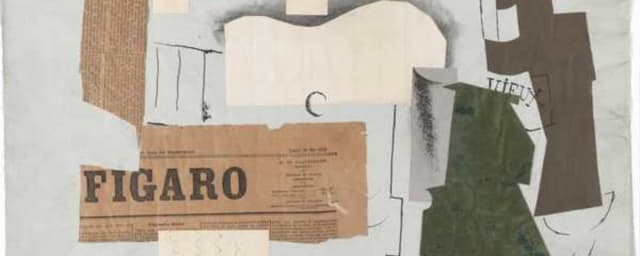
Mixed media
Mixed media is a term describing artworks made from a combination of different materials or means of expression within a single image or object. For instance, a drawing might combine graphite pencil, ink, watercolour, and pasted paper elements, while a painting might unite oil paint with collage or everyday objects. The practice of systematically mixing media became a defining feature of twentieth-century art, when the boundaries of traditional techniques began to be deliberately broken down. A turning point was the invention of collage by the Cubists Pablo Picasso and Georges Braque around 1912, when newspaper, wallpaper, and fabric were first glued onto the painted surface. Mixed media developed further in Dada, Surrealism, and the art of assemblage. The term is distinct from «multimedia», which usually implies an electronic or time-based component. Mixed media gave artists an almost limitless freedom of materials and became one of the defining traits of modern and contemporary art.
Read more →
Mobile
A mobile is a type of sculpture made of delicate components suspended in the air, which move in response to air currents or mechanical force. Unlike static sculpture, a mobile continually changes its configuration, so the viewer never sees it the same way twice: balance, line and space are in constant motion. A mobile usually consists of thin metal rods and flat coloured elements, balanced so that the slightest breath of air sets the whole structure into subtle oscillation. The genre was invented by the American sculptor Alexander Calder in the late 1920s and early 1930s; the name "mobile" itself was suggested by Marcel Duchamp. Calder's abstract compositions of coloured metal "petals" became classics of kinetic art and influenced the understanding of sculpture as an art of time and movement rather than mass alone. The opposite concept, also coined by Jean Arp, is the "stabile" — a stationary construction. Mobiles influenced interior design, children's hanging toys and many twentieth-century artists, affirming the idea that sculpture can be light, airy and ever-changing.
Read more →
Modernism
Modernism is a broad artistic paradigm of the late nineteenth to mid-twentieth centuries that united the drive to renew the language of art radically, to break with the academic tradition and to find forms consonant with the experience of the modern human being. Its engine was a belief in innovation, the autonomy of art and the intrinsic value of artistic form, and its motto was Ezra Pound's call to "make it new." Modernism is not a single style but a genealogical tree of movements: Post-Impressionism, Symbolism, Fauvism, Cubism, Futurism, Expressionism, abstraction, Suprematism, Constructivism, Surrealism and Dada. Their common features are a departure from mimetic depiction toward stylization and abstraction, attention to the medium itself (the flat surface, colour, texture), experiment with form, fragmentation and reflection on the language of art. Its pivotal figures are Paul Cézanne, Pablo Picasso, Henri Matisse, Wassily Kandinsky and Piet Mondrian. Ukrainian Modernism is a powerful and distinctive phenomenon: Kazimir Malevich with Suprematism, Oleksandr Bohomazov, Aleksandra Exter, the school of the Boichukists led by Mykhailo Boichuk, which fused Byzantine monumentality with the avant-garde, the graphic art of Heorhii Narbut and the architecture of Ukrainian Art Nouveau. In a wider sense Modernism embraced architecture (Functionalism, the Bauhaus), design, literature and music, affirming the image of the artist as innovator. Its era ends in the second half of the twentieth century, giving way to postmodernism, which cast doubt on the modernist faith in progress, originality and the grand narrative ambition of art.
Read more →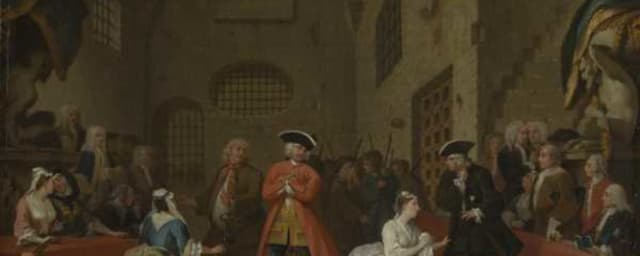
Modern moral subject
The 'modern moral subject' is a type of painting invented by the English artist William Hogarth (1697-1764), which satirically depicted the manners and morals of the society of his day. Hogarth deliberately created a new genre, combining the sharpness of political caricature with the narrative quality of history painting, but directing them toward a critique of the vices of everyday life in his age — debauchery, vanity, greed, drunkenness and hypocrisy. He himself compared his role to that of a playwright and his pictures to theatrical performances about life. Hogarth created his most famous modern moral subjects in the form of series of several pictures, which he then disseminated as affordable engravings for a wide public. Among them are A Harlot's Progress (1731), A Rake's Progress (1732-1735) and Marriage A-la-Mode (1743-1745), in which an instructive story of moral decline and inevitable retribution unfolds step by step. Every detail in these compositions carries a symbolic charge and requires attentive 'reading'. Hogarth founded the tradition of English satirical printmaking and socially critical art, influencing the subsequent development of caricature, illustration and the realist depiction of social vices.
Read more →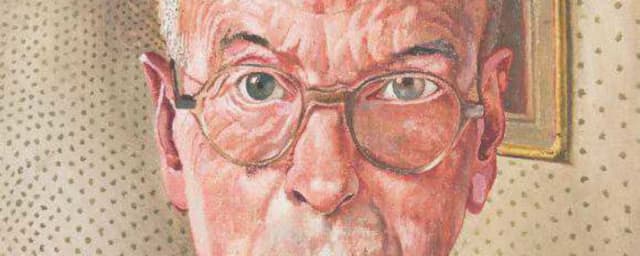
Modern realism
Modern realism is a term denoting painting and sculpture made after the development of abstraction in modern art, but which continue to depict the visible world in a realistic, recognisable way. Unlike the academic realism of the nineteenth century, modern realism exists in conditions where abstraction has become an accepted and even dominant artistic language, so that a return to the figurative takes on a conscious, sometimes oppositional character. Artists of modern realism combine truthful observation of nature with a modern sensibility, compositional freedom and psychological tension, often depicting everyday life, the urban environment, the portrait or the interior. Among the masters associated with this tendency are Edward Hopper, with his lonely urban scenes, Lucian Freud, with his sharp corporeal portraits, Andrew Wyeth and others. Modern realism demonstrates that realistic depiction is not a relic of the past but remains a living and relevant means of reflecting on humanity and the world in an age that has witnessed the triumph of abstract art.
Read more →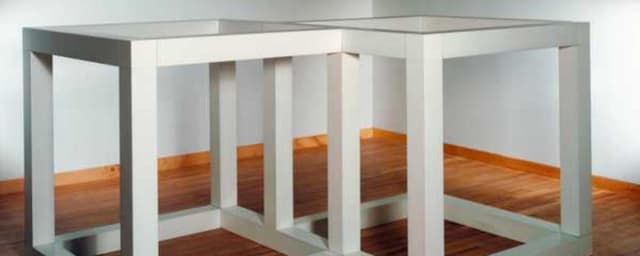
Modular
Modular is a term used in connection with Minimalism to denote an artwork composed of repeated identical parts, or modules, that can be moved, separated, and rejoined. A module is a standard unit from which, by the principle of repetition and combination, the entire structure of the work is built. This approach rejects the idea of a unique, hierarchically constructed composition in favour of an impersonal, serial logic often associated with industrial production. Modularity became one of the central ideas of 1960s Minimalism in the United States. Donald Judd created «progressions» and stacks of identical metal boxes, Carl Andre laid out floor pieces from identical bricks or metal plates, and Sol LeWitt built open cubic lattice structures. The modular principle is linked to serial art and emphasises the system, the set of rules, and the relationships between elements rather than the artist's individual gesture, radically transforming the conception of twentieth-century sculpture.
Read more →
Monochrome
Monochrome means "of one colour"; in art a monochrome work is one executed in a single colour or in its shades and tones. The artist limits the palette to one pigment, working instead with gradations of light and dark, surface texture, materiality and form. Monochrome painting focuses attention on the very essence of colour and the flat plane, freeing the canvas from depiction and narrative. Historically the monochrome manner appeared in grisaille — painting in grey tones imitating relief — and in tonal drawings. As a radical avant-garde gesture, the monochrome emerged in the early twentieth century, when black and white canvases became manifestos of pure art. In the 1950s and 1960s Yves Klein registered the formula of the saturated ultramarine IKB (via a Soleau envelope, 1960) and created a series of purely blue paintings, Robert Rauschenberg made white canvases and Ad Reinhardt near-black ones. The monochrome raised questions about the limits of painting, the presence of the viewer and colour as a self-sufficient event. The tendency is closely linked with abstraction, Minimalism and Conceptual art and remains an influential strategy for contemporary artists, including in Ukrainian abstract painting.
Read more →
Mono-ha
Mono-ha (Japanese for 'school of things') is a pioneering art movement that emerged in Tokyo in the mid-1960s and early 1970s. Instead of making traditional representational works, its artists explored materials themselves — stone, steel, glass, wood, water, soil, paper — and their natural properties, interaction and arrangement in space. Mono-ha artists reduced intervention to a minimum, leaving things as close as possible to their natural state and emphasising the relationships between elements rather than the objects themselves. The leading figure of the movement was Lee Ufan, a theorist and artist of Korean origin who in his writings drew on phenomenology and Eastern philosophy. Other participants include Nobuo Sekine, whose work 'Phase — Mother Earth' (1968), a huge cylinder of compacted earth beside a pit of the same shape, is regarded as emblematic of the movement, as well as Kishio Suga and Susumu Koshimizu. Mono-ha echoes Minimalism and Land art but is distinguished by a particular attention to emptiness, transience and contemplation rooted in the Asian aesthetic tradition.
Read more →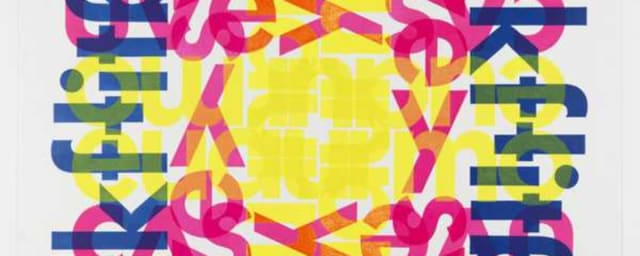
Monoprint
Monoprint is a form of printmaking in which an impression of a given image can be produced only as a single copy, unlike most types of printing that allow many identical impressions to be made. Unlike pure monotype, a monoprint has a fixed matrix — an engraved, etched, or otherwise worked plate with an unchanging underlying design — but each time it is re-inked by hand, with added colours, wiping, or brushstrokes, so that every impression becomes unique. Thus a repeatable printed element and a singular painterly gesture are combined. The term is often used alongside monotype, and the boundary between them can be blurred. Monoprint appeals to artists for its freedom of experiment, its blend of chance and control, and its richness of texture and colour. The technique was used by Edgar Degas and Paul Gauguin, and in the twentieth century by many masters seeking individuality within the printed medium, including representatives of the Ukrainian graphic school who valued the singularity of each sheet.
Read more →
Monotype
Monotype is a unique image printed from a smooth, non-porous plate, such as glass or metal, onto which a design has been drawn in paint or ink. The artist draws freely on the surface of the plate and then presses a sheet of paper against it, transferring the image; because most of the paint passes to the paper in a single impression, it is impossible to obtain a second identical print — hence the name «mono», meaning single. Monotype combines the spontaneity of painting or drawing with the soft, slightly blurred quality of a printed image and the unpredictable effects that arise under pressure. The earliest examples of the technique are attributed to the seventeenth-century Italian master Giovanni Benedetto Castiglione. Later, monotype was used brilliantly by Edgar Degas, who created series with effects of light and movement. In the twentieth century, the technique attracted many artists for its freedom and immediacy, including masters of Ukrainian graphics, for whom it became a field of experiment with texture, tone, and colour on the border between painting and print.
Read more →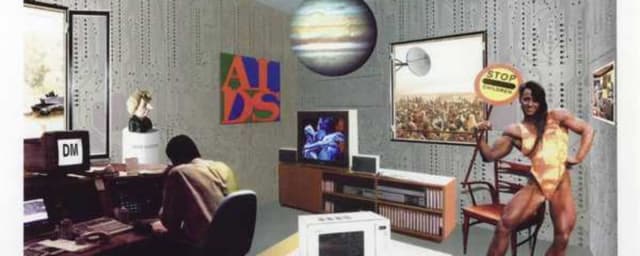
Montage
Montage is an assembly of images interrelated in such a way that they form a single unified work or part of one. The term derives from the French monter, «to mount» or «to assemble», and was first used in cinema to denote the splicing of separate shots into a meaningful sequence. In the visual arts, montage means the composing of ready-made images — newspaper clippings, photographs, reproductions — into a new composition that generates unexpected meanings through their juxtaposition. A variety of montage is photomontage, which the Dadaists turned into a sharp political weapon during and after the First World War: Hannah Höch, Raoul Hausmann, and especially John Heartfield created scathing anti-militarist and anti-fascist images by cutting and combining fragments of the mass press. Montage is founded on the principle of juxtaposition, where meaning arises not within a single image but between images. This technique profoundly influenced modern graphics, the poster, advertising, and contemporary digital art.
Read more →
Mosaic
Mosaic is an image composed of small particles, traditionally little cubes (tesserae) of terracotta, coloured glass, ceramic, stone, or marble, set into mortar on floors, walls, and vaults. The art of mosaic has a history spanning millennia: it developed in Mesopotamia, reached refinement in Hellenistic Greece and Rome, where it adorned the floors of villas, and attained its highest spiritual expression in Byzantine sacred art. Byzantine masters used smalti — opaque coloured glass, often backed with a thin layer of gold — so that the shimmering surfaces of churches seemed to glow from within. This tradition had a decisive influence on Kyivan Rus. The most outstanding monument of Ukrainian mosaic is the ensemble of St Sophia's Cathedral in Kyiv from the eleventh century, notably the majestic «Virgin Orans» in the apse, executed from millions of smalti cubes. The art of mosaic experienced a revival in Art Nouveau and in twentieth-century monumental art, retaining exceptional durability and radiant colour.
Read more →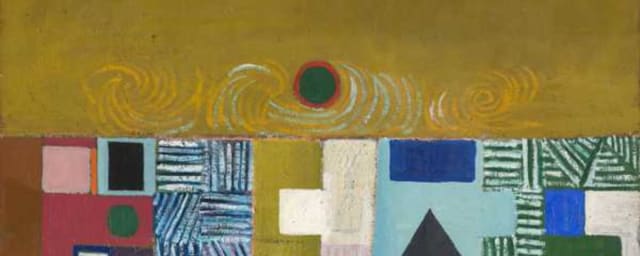
Motif
A motif in art is a recurring element, image, theme or pattern that appears in a work and plays a structural or semantic role in its construction. A motif may be a specific object (a skull, a flower, a window), a formal device (a particular line, shape or patch of colour), or a recurring subject or theme to which an artist returns again and again throughout their oeuvre. The repetition of a motif creates rhythm, unity and internal connections, enriching perception and lending the work additional layers of meaning. The concept of the motif is especially important for the analysis of decorative art and ornament, where the repetition and variation of a given element is the basis of composition. At the same time, in a broader sense the motif denotes the particular fragment of the visible world that an artist chooses as the subject of depiction: thus the Impressionists spoke of the 'motif' in nature, and Paul Cezanne repeatedly returned to one favourite motif — Mont Sainte-Victoire — studying it in different light and seasons. In a wider cultural context, recurring motifs — the tree of life, the labyrinth, the mirror — travel across epochs and styles, binding works of art into a single tradition of images and symbols.
Read more →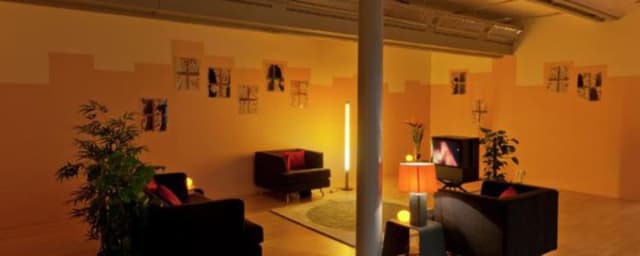
Multi-media
Multi-media is a term first used in the 1960s to describe mixed-media works that contained an electronic component. Unlike simple «mixed media», where traditional materials are combined, multi-media implies the introduction of technological elements — light, sound, film, video, slides, and later computer systems — into an artwork, often within a performance or environment. The development of multi-media was spurred by the happenings and events of the Fluxus movement, as well as by experiments at the intersection of art and technology. A landmark example of early multi-media was Andy Warhol's «Exploding Plastic Inevitable» with the band The Velvet Underground, which combined music, film, light projections, and dance. Multi-media practices were advanced by video artists, notably Nam June Paik, regarded as one of the founders of video art. With the advent of digital technologies at the end of the twentieth century, multi-media expanded into interactive installations and new-media art, becoming one of the leading forms of contemporary artistic creation.
Read more →



