




Art terms on "A"
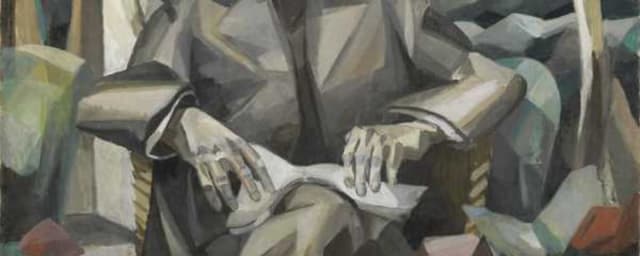
Abbaye de Créteil
Abbaye de Créteil was a short-lived utopian community of French writers, artists, and composers founded in the autumn of 1906 in the town of Créteil, just outside Paris. Its name evokes the Abbey of Thélème in François Rabelais's Gargantua and Pantagruel, whose sole rule was "do as you wish": the members hoped to build a self-sufficient community that would support itself through its own printing press and free artists from the pressures of the commercial market. The nucleus of the group comprised the poets and novelists Georges Duhamel, Charles Vildrac, and René Arcos, joined by the painter Albert Gleizes, the composer Albert Doyen, and others. Aesthetically the circle is linked with "Unanimism," the idea of a shared, collective soul animating the crowd and the modern city. Despite its lofty ideals, financial hardship forced the community to disband as early as 1908, yet its experiment in communal living and cooperative publishing influenced later avant-garde associations across Europe.
Read more →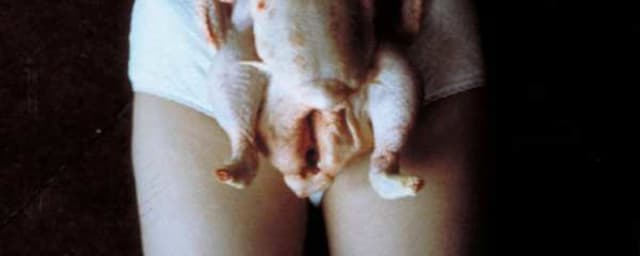
Abject art
Abject art comprises works that explore themes disturbing and threatening to our sense of cleanliness, integrity and decency, in particular by referring to the body and its functions. The term derives from the Latin abicere, to cast off, and draws on the theory of the philosopher and psychoanalyst Julia Kristeva set out in her essay Powers of Horror (1980). Kristeva described the abject as that which a person expels in order to preserve their own boundaries, secretions, bodily fluids, decay, everything that blurs the border between subject and object. As an artistic category abject art became prominent in the late 1980s and the 1990s, when artists deliberately turned to the repulsive, the corporeal and the taboo in order to challenge ideals of beauty and social norms. The tendency often includes the work of Cindy Sherman, Robert Gober, Kiki Smith and Paul McCarthy. Using images of the body, illness, death and bodily waste, these artists raised questions of identity, gender, mortality and social repression, forcing the viewer to confront what is usually concealed.
Read more →
Abstract
Abstraction is an artistic language that abandons the recognizable depiction of the material world and constructs the image from the pure means of painting and drawing: color, line, plane, rhythm and texture. Instead of imitating nature, an abstract work appeals to inner experience, musical association or spiritual idea, asserting the self-sufficiency of formal elements. Historically two principal currents are distinguished: lyrical, or organic, abstraction with flowing colored patches and an expressive gesture, and geometric abstraction with clear figures, right angles and calibrated proportions. The style's hallmarks are an open composition, the autonomous voice of color, attention to the very process of applying paint, and the refusal of narrative. Technically artists employ washes, dripping, collage, monochrome fields or, conversely, contrasting juxtapositions of tone. Wassily Kandinsky, for whom color carried a "spiritual sound," is regarded as the founder; alongside him worked Piet Mondrian with his Neoplasticism and Robert Delaunay with Orphism. In the Ukrainian context abstract inquiry involves Kazimir Malevich and his Suprematism, as well as Alexandra Exter, whose non-objective compositions fused color and dynamism. In the second half of the twentieth century abstraction unfolded in American Abstract Expressionism through Jackson Pollock and Mark Rothko. Abstraction permanently changed ideas about what could be the subject of art, opening the way to non-objective painting, color field and minimalism.
Read more →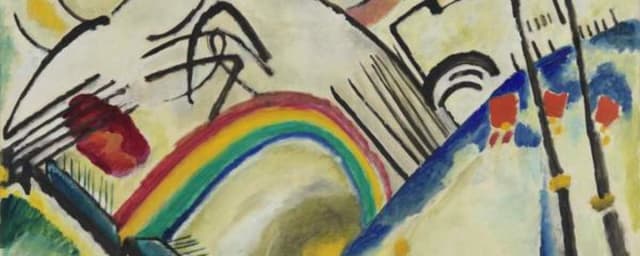
Abstract art
Abstract art comprises works that do not attempt to represent visual reality accurately but instead use forms, colours, lines, volumes and gestural marks to achieve their effect. Abstraction may depart from the visible world partially, by simplifying or stylising it, or completely, when the image bears no reference to recognisable objects. The aim is to express ideas, emotions, rhythms and spiritual states through a purely plastic language. Abstract art took shape in the early twentieth century as a logical extension of the experiments of Post-Impressionism, Fauvism and Cubism. One of its founders is considered to be Wassily Kandinsky, who had close ties to Ukraine and studied in Odesa; his theoretical work Concerning the Spiritual in Art (1911) argued for the possibility of non-objective painting. Important contributions came from Kazimir Malevich, the creator of Suprematism who was closely connected with Kyiv, and from Piet Mondrian with Neoplasticism. Abstraction branched into geometric and lyrical tendencies and remains one of the defining languages of modern art.
Read more →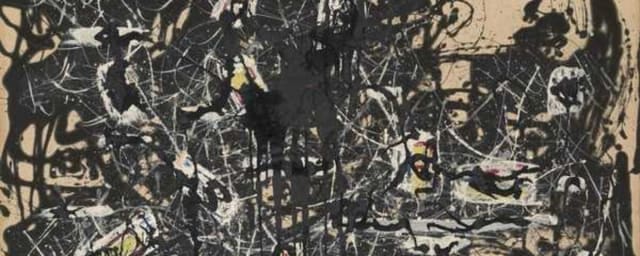
Abstract expressionism
Abstract Expressionism is a term applied to new forms of abstract art developed by American artists in the 1940s and 1950s. These works are often characterised by gestural brushstrokes or mark-making, large scale, and an impression of spontaneity and direct emotional expression. The movement was the first to make New York, rather than Paris, the centre of the postwar art world. Two main tendencies are distinguished within it. The first is action painting, represented by Jackson Pollock, who poured and dripped paint onto canvas spread on the floor, and Willem de Kooning with his energetic strokes. The second is colour field painting by Mark Rothko and Barnett Newman, in which large areas of colour create a meditative, almost sacred effect. The movement was shaped by Surrealism, the idea of automatism and the experience of European émigrés. Abstract Expressionism emphasised the process of creation, the individual gesture and psychological depth, becoming decisive for the development of postwar art.
Read more →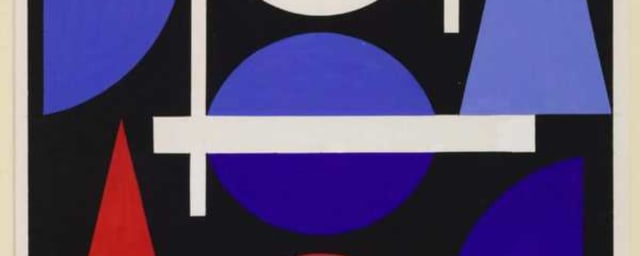
Abstraction-Création
Abstraction-Création was an association of abstract artists founded in Paris in 1931 to promote abstract art through group exhibitions and publications. The association arose partly as a response to the dominance of Surrealism and sought to bring together artists working in a non-objective direction, giving them a shared platform to show their work and exchange ideas. The group was open and international, numbering hundreds of members from many countries over its years. Among its leading figures were Auguste Herbin, Jean Hélion, Theo van Doesburg (a driving force in the early stage), Naum Gabo, Antoine Pevsner, Hans Arp, Piet Mondrian and Wassily Kandinsky. The association published an annual almanac of the same name that reproduced works and printed theoretical texts. Abstraction-Création united different tendencies, from geometric abstraction and Constructivism to Neoplasticism, and although it lasted only until the mid-1930s, it played a key role in consolidating and spreading abstract art across interwar Europe.
Read more →
Académie Colarossi
The Académie Colarossi was a private art school in the Montparnasse district of Paris, founded in the second half of the nineteenth century by the Italian sculptor Filippo Colarossi. It arose as a democratic alternative to the official and conservative École des Beaux-Arts: tuition was inexpensive, foreign students were welcomed, and life-drawing classes were available daily. The academy's particular significance lay in being among the first to admit women artists and, unlike the state school, to allow them to draw from the nude male model on equal terms with men. Colarossi's studios attracted numerous artists from around the world, including Scandinavian, American, and British painters who came to Paris for a European training. Together with the neighbouring Académie Julian, the school became an important centre of the cosmopolitan artistic life of turn-of-the-century Montparnasse, until it finally closed its doors in the 1930s.
Read more →
Académie Julian
The Académie Julian was a private art school founded in Paris in 1868 by the painter Rodolphe Julian. It became the principal alternative to the official École des Beaux-Arts, above all because it admitted women, whom the state school excluded from enrolment until 1897. The academy prepared students for the entrance examinations of the state school, offered intensive work from the model under celebrated academic masters such as William Bouguereau and Jean-Paul Laurens, and imposed no restrictions of origin or nationality, thereby attracting artists from all over the world. It was here that the future Nabis—Maurice Denis, Pierre Bonnard, Édouard Vuillard, and Paul Sérusier—trained, along with numerous American, Canadian, and Eastern European painters. Through its openness and its high standard of teaching, the Académie Julian played a key role in shaping the modernist generation at the turn of the nineteenth and twentieth centuries.
Read more →
Academism
Academism is both a style and a system of artistic education that formed around the European academies of art from the seventeenth to the nineteenth century, codifying a strict hierarchy of genres, canons and technical rules. Its aesthetic ideal is a measured beauty grounded in the study of antique sculpture and the legacy of the High Renaissance masters, above all Raphael. An academic work is marked by impeccable drawing, careful modeling of volume through chiaroscuro, a smooth, almost invisible handling of the brushstroke, and a balanced, often pyramidal composition. At the summit of the genre hierarchy stood history painting — scenes from mythology, religion and ancient history — while portrait, genre, landscape and still life ranked below. Precise anatomy, linear perspective and the idealization of nature, smoothing away the accidental and elevating the exemplary, were obligatory. The leading masters of academism were Jean-Auguste-Dominique Ingres, William Bouguereau and Alexandre Cabanel, The Ukrainian academic tradition is represented by Volodymyr Borovikovsky, a native of Myrhorod. The fate of many Ukrainian artists is also bound to the Imperial Academy of Arts, notably Taras Shevchenko, who received his professional training there. In the later nineteenth century academism was criticized by realists and impressionists for its cold convention and detachment from modern life, and the term "salon art" acquired an ironic tinge. Yet the academic school of drawing remains to this day the foundation of an artist's professional formation.
Read more →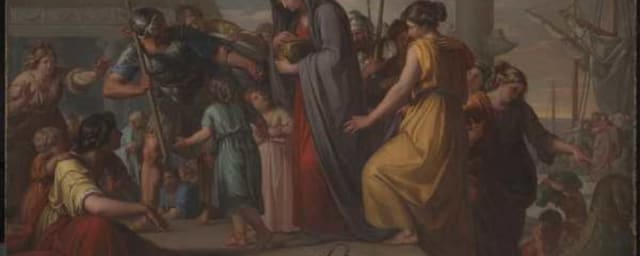
Academy
An academy is a type of artist-run organisation whose aim was to raise the professional and social status of the artist and to provide systematic training. The word derives from the grove of Akademos near Athens where the philosopher Plato taught, and by the Renaissance it had come to denote learned assemblies. The first true art academy is usually considered the Florentine Accademia del Disegno, founded in 1563 with the involvement of Giorgio Vasari under the patronage of Cosimo de' Medici; it asserted the idea that painting, sculpture, and architecture were liberal intellectual arts rather than mere crafts. On its model arose the Accademia di San Luca in Rome, the French Royal Academy of Painting and Sculpture (1648), and the Royal Academy of Arts in London (1768) headed by Joshua Reynolds. Academies established hierarchies of genres, canons of taste, and annual salon exhibitions, and in time became themselves symbols of the conservatism against which the avant-gardes of the nineteenth and twentieth centuries rebelled.
Read more →
Acrylic paint
Acrylic paint is a water-soluble, fast-drying paint based on a synthetic acrylic polymer emulsion, in which pigment is suspended in a poly-methyl-acrylate binder. It was invented in the mid-twentieth century: the first artists' acrylic paints appeared in the United States and Mexico in the 1940s and 1950s, and became commercially available from the 1950s. From the 1960s onward acrylic gained wide popularity among artists thanks to its versatility, durability and ease of use. Depending on the amount of water added, acrylic can be applied either as a dense, impasto layer resembling oil or as transparent glazes similar to watercolour. The paint dries within minutes, after which it becomes water-resistant and flexible, barely changing colour or yellowing over time. Acrylic adheres well to a variety of supports — canvas, paper, wood, metal — and, with additional mediums, an artist can adjust its gloss, texture and drying time. These qualities made acrylic a favoured material for color field painters, Pop artists and many contemporary artists. Masters such as Mark Rothko, David Hockney, Morris Louis and Andy Warhol made extensive use of acrylic paints in their work.
Read more →
Actionism
Actionism is the English term for the Viennese group Wiener Aktionismus (Viennese Actionism), founded around 1962. It was a radical movement in performance art whose actions were deliberately shocking and often involved self-harm, the use of blood, animal carcasses, bodily fluids and ritualised violence. The artists sought to break down the boundaries between art and life, to provoke the viewer and to expose the hidden aspects of the human psyche, sexuality and collective trauma. The main members of the group were Hermann Nitsch, Günter Brus, Otto Muehl and Rudolf Schwarzkogler. Their actions unfolded in the context of postwar Austria and reacted against repressed memory, conservative morality and the legacy of totalitarianism. The most ambitious project was Hermann Nitsch's Orgies Mysteries Theatre, multi-day ritual events with a complex symbolism of sacrifice and catharsis. Viennese Actionism had a significant influence on the development of performance, body art and conceptual art, affirming the body and direct action as a fully valid artistic means and a means of social provocation.
Read more →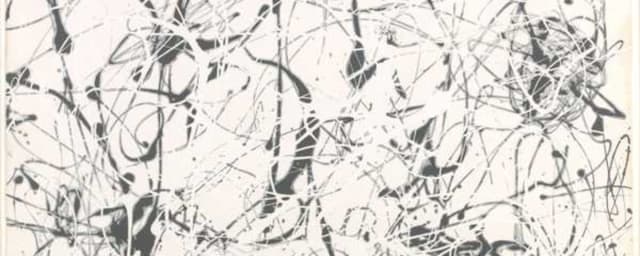
Action painters
Action painters were artists who worked from the 1940s to the early 1960s and whose approach to painting emphasised the act of creation itself as an integral part of the finished work. Instead of carefully planning the composition, they applied paint in drips, splashes, spatters and energetic gestural strokes, often laying the canvas on the floor and moving around it. The trace of each bodily movement was recorded on the surface, turning the painting into a record of the artist's physical action and mental state. The term action painting was coined by the critic Harold Rosenberg in an essay of 1952, contrasting this approach with the traditional idea of a painting as an image. The best-known representative is Jackson Pollock with his pouring and dripping techniques; the circle of action painters also includes Willem de Kooning, Franz Kline and other masters within the broader Abstract Expressionist movement. The idea that the canvas is an arena for action rather than a space for representation deeply influenced the later development of performance, the happening and process art.
Read more →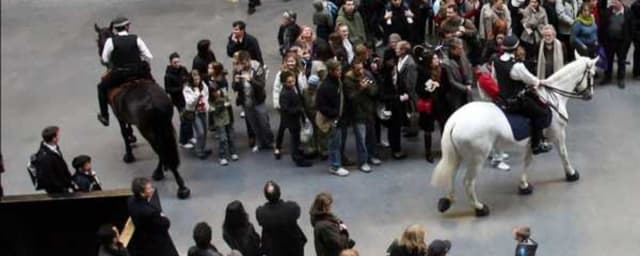
Activist art
Activist art is a term describing art grounded in the act of doing and raising political or social issues. Unlike works meant to be contemplated in a gallery, activist art seeks to intervene directly in social processes, to draw attention to injustice, to mobilise communities and to prompt change. It often moves beyond the museum into the streets, public space and the digital environment. The roots of the tendency reach back to the avant-garde movements of the early twentieth century and the political art of the 1930s, but as a distinct practice it took shape from the 1960s and 1970s, in the context of the civil rights struggle, the feminist movement and anti-war protest. Activist artists and collectives use posters, performance, street art, installation and media campaigns; well-known examples include the Guerrilla Girls collective, which combats gender and racial inequality in the art world. Activist art is closely linked with socially engaged practice and blurs the boundary between artistic creation and civic action, emphasising art's function as an instrument of social transformation.
Read more →
Aesthetic movement
The Aesthetic Movement advocated pure beauty and the principle of art for art's sake (l'art pour l'art), emphasising the visual and sensual qualities of art and design over practical, moral or narrative aspects. Its adherents rejected the Victorian demand that art should instruct or serve a social purpose, arguing instead that a work justified itself through its existence and beauty alone. The movement flourished in Britain in the 1860s to 1880s and embraced not only painting but also the decorative arts, literature and interior design. Among its leading figures was the painter James Abbott McNeill Whistler, whose nocturnes and symphonies likened painting to music, and the writer Oscar Wilde, who became an eloquent spokesman for aestheticism. Important contributions came from Dante Gabriel Rossetti and Edward Burne-Jones. In the decorative sphere the movement expressed itself through motifs of the sunflower, the peacock feather and Japanese art. The Aesthetic Movement prepared the ground for Symbolism, Art Nouveau and the modernist idea of the autonomy of art.
Read more →
Aesthetics
Aesthetics is the branch of philosophy concerned with the nature of beauty, taste, art, and sensory perception. The term derives from the Greek word aisthesis, meaning sense perception, and was introduced into philosophical discourse by the German thinker Alexander Gottlieb Baumgarten in 1735 (in his thesis Meditationes philosophicae de nonnullis ad poema pertinentibus) and developed in his Aesthetica (1750); Baumgarten defined aesthetics as the science of sensory knowledge. Aesthetics poses fundamental questions: what makes an object beautiful, whether beauty is an objective property of things or resides only in the eye of the beholder, and what criteria distinguish art from other forms of human activity. Major contributions to aesthetics came from Immanuel Kant, whose Critique of Judgment distinguished between the beautiful and the sublime, and from Georg Hegel with his philosophy of art. In the twentieth century, aesthetics expanded to address the status of the avant-garde, mass culture, and conceptual art, questioning whether beauty remains a necessary condition of art at all. For art history and criticism, aesthetics remains a foundational discipline, shaping the criteria by which works are evaluated, analysed, and interpreted, and framing how societies understand taste and artistic value.
Read more →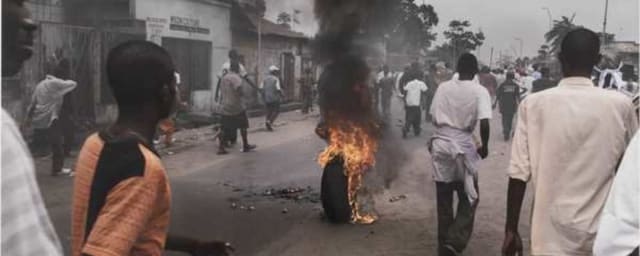
Afrapix
Afrapix was a collective of photographers and an agency founded in South Africa in 1982, which encouraged its members to use photography as a means of activism against the apartheid regime. It arose as a democratic, multiracial community determined to document everyday life, resistance and violence under racial segregation, at a time when the official media suppressed the truth. Its members, among them Paul Weinberg, Omar Badsha, Gideon Mendel and Santu Mofokeng, photographed protests, strikes, funerals and the daily life of the black majority, building a powerful archive of what became known as "struggle photography." Afrapix combined aesthetic quality with political commitment, distributing images through the independent press and international channels to draw the world's attention. The collective's experience is a vivid example of how documentary photography becomes an instrument of civic resistance and witness, a theme that resonates with the Ukrainian experience of recording historical truth in times of trial.
Read more →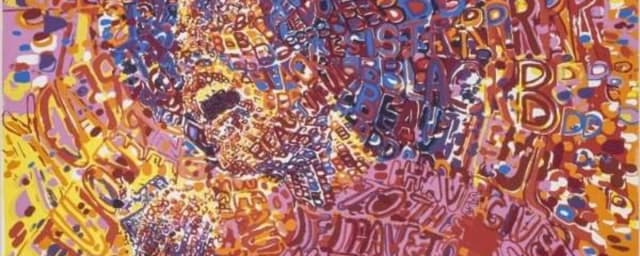
AfriCOBRA
AfriCOBRA, an acronym for the African Commune of Bad Relevant Artists, is a group of African American artists founded in Chicago in 1968. It grew out of the Chicago collective OBAC and the experience of creating the mural Wall of Respect, and its founders included Jeff Donaldson, Wadsworth Jarrell, Jae Jarrell, Barbara Jones-Hogu, and Gerald Williams. The artists sought to develop a distinctly Black aesthetic, rooted in African American and African culture, that would empower the community. Their visual language relied on bright "Kool-Aid" colours, rhythmic patterns, calligraphic lettering, positive images of Black people, and messages of dignity and unity. AfriCOBRA became one of the leading artistic forces of the Black Arts Movement and, in parallel with the struggle for civil rights, championed an art oriented not toward the museum but toward the community itself—accessible and legible to a broad audience.
Read more →
Afrofuturism
Afrofuturism is a cultural aesthetic that explores the African American and broader Black experience and seeks to connect members of the Black diaspora with their heritage through the lens of science, technology and imagined futures. The tendency weaves together elements of science fiction, history, cosmology, African myth and fantasy in order to reimagine the past and project alternative futures in which Black people are full subjects and creators. The term was proposed by the cultural critic Mark Dery in his essay 'Black to the Future' (1993; reprinted in Flame Wars, 1994), but the practice has deeper roots, notably in the music of Sun Ra, who from the 1950s developed a cosmic mythology, and later in the work of the band Parliament-Funkadelic and the writer Octavia Butler. In the visual arts Afrofuturism is engaged by artists using collage, digital media and installation. Afrofuturism reflects on the legacies of slavery and colonialism, on questions of identity, technology and liberation, offering visions of worlds free of racial oppression, and it has become influential in film, fashion, literature and music.
Read more →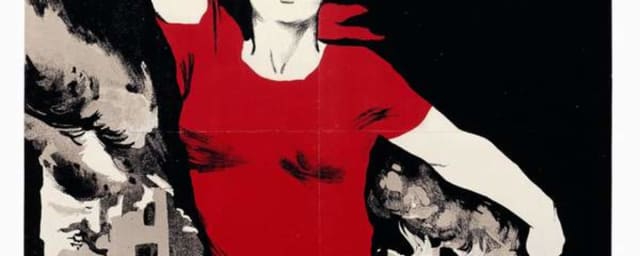
Agit-prop
Agit-prop, a contraction of agitation and propaganda, denotes the Department of Agitation and Propaganda set up by the Soviet Communist Party in 1920 to control the ideological education of the masses and to spread official ideology. The term later acquired a broader meaning and came to be applied to any art that openly serves political propaganda, using direct, accessible and emotionally charged imagery to influence mass consciousness. In visual culture agit-prop manifested through posters, the staging of mass festivals, painted agitation trains, photomontage and theatrical events. In the 1920s Constructivist artists, notably El Lissitzky and Alexander Rodchenko, developed a dynamic graphic language of bold type, diagonal compositions and photomontage intended to mobilise the viewer. In Ukraine of this period distinct avant-garde schools developed, while official propaganda sought to subordinate art to the ideological tasks of the totalitarian state. Historically agit-prop is an important example of how artistic means became an instrument of political control, and its visual devices later influenced graphic design and advertising.
Read more →
Airbrushing
Airbrushing is a painting technique in which paint is atomized by compressed air through an airbrush, a small pneumatic tool. It allows the creation of even, uniform surfaces, soft tonal transitions, and smooth gradients without visible brushwork, which is why it is often used to achieve a high degree of realism. The airbrush appeared in the late nineteenth century and was first used for retouching photographs and for commercial illustration. In the twentieth century it was widely applied in poster art, advertising, automotive design, and scientific illustration. In fine art, airbrushing became an important tool for Photorealists and Pop artists; Audrey Flack, for example, used it for smooth, almost photographic surfaces. The term airbrushing is also used figuratively to mean retouching or removing unwanted details from an image. The technique requires precise control of pressure and distance, along with stencils or masks to define crisp shapes.
Read more →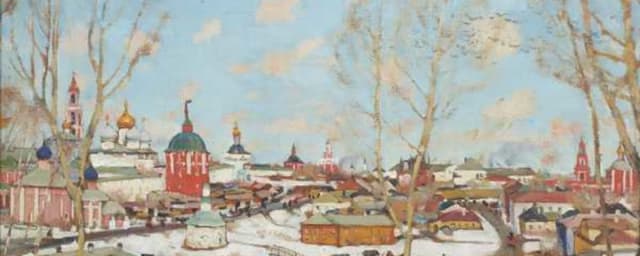
AkhRR
AkhRR (renamed the Association of Artists of the Revolution, AkhR, in 1928) was a group founded in 1922 in the Soviet capital that became the largest and most influential artistic organisation of the early Soviet period. Emerging soon after the Bolshevik takeover, it proclaimed a programme of "heroic realism": artists were to depict, in a documentary manner legible to the masses, the everyday life of workers, peasants, and Red Army soldiers, as well as the events of the revolution and civil war. The association deliberately rejected avant-garde experiment and drew on the traditions of nineteenth-century realist genre painting, mounting large thematic exhibitions under the slogan of the "artistic-documentary" recording of the new age. Its members included Isaak Brodsky, Mitrofan Grekov, and other masters. Enjoying the support of the state and the army, AkhRR effectively prepared the ground for the official doctrine of Socialist Realism proclaimed in the early 1930s, after which all artistic groupings were forcibly dissolved and subordinated to a single creative union.
Read more →
Alabaster
Alabaster is a soft, fine-grained stone used in sculpture and decorative art. The term covers two distinct minerals: gypsum alabaster (hydrated calcium sulphate), common in ancient and medieval times, and calcite alabaster, or "oriental alabaster" (calcium carbonate), known to the Egyptians and Greeks. Both varieties are soft, white or translucent, and readily carved, polished and tinted, which makes them attractive for fine work. Because of its softness and its ability to transmit light, alabaster was prized in antiquity: it was used to make vases, perfume vessels and funerary objects in ancient Egypt and Mesopotamia. In medieval Europe, especially in England (Nottingham) and Spain, alabaster was carved into religious reliefs, altarpieces and tombs, often painted and gilded. In the Baroque era the translucent stone was used for decorative details, lamps and sculptures. The main drawback of alabaster is its solubility in water and vulnerability to moisture, so objects made from it are intended for interiors. Today alabaster remains a material both for restorers of historic monuments and for contemporary sculptors who value its soft luminosity.
Read more →
Albumen print
The albumen print is a type of photographic print invented in 1850 and widely used through the second half of the nineteenth century. It was made from paper coated with albumen (egg white) mixed with salts, then sensitised with a silver solution; the image formed directly under the action of light through a negative. Developed by Louis Désiré Blanquart-Evrard, the method produced a smooth glossy surface, fine detail and characteristic warm, purplish-brown tones, especially after gold toning. The albumen print became the dominant positive-printing technology for decades and prevailed in the era of the carte-de-visite portrait and the landscape view. Enormous numbers of nineteenth-century photographs were made in this technique, including early views of Ukrainian towns, architectural monuments and people, which are now valuable historical sources. Because of their organic base, such prints tend to yellow and fade over time and require careful preservation in museum and archival collections.
Read more →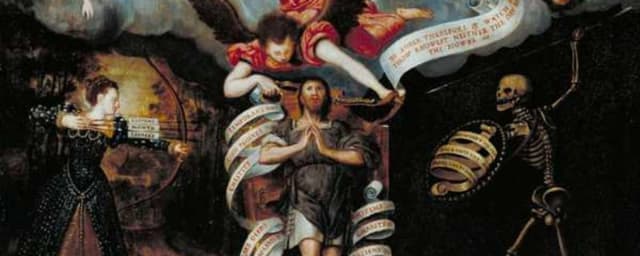
Allegory
Allegory in art is a device by which depicted objects, figures or whole scenes symbolize a deeper meaning — usually moral, religious or philosophical — that goes beyond the literal subject. Abstract concepts such as Justice, Love, Death, Peace, Time, virtues and vices are embodied in recognizable personified figures, often equipped with characteristic attributes: scales and a blindfold for Justice, a scythe and hourglass for Time or Death. Reading such images requires knowledge of iconographic codes that developed over centuries. Allegory has ancient roots in antiquity and flourished in the art of the Middle Ages, the Renaissance and the Baroque, when painters such as Sandro Botticelli, Titian, Peter Paul Rubens and Nicolas Poussin created complex allegorical compositions for princely, ecclesiastical and state patrons. Reference works such as Cesare Ripa's Iconologia (1593) codified the standard ways of depicting abstract concepts. Allegory remained a powerful means of political and moral rhetoric for centuries and retains its relevance in contemporary art, where artists often turn to symbolic language to comment on social, ecological and ideological questions.
Read more →
Altermodern
Altermodern is a term the curator and theorist Nicolas Bourriaud introduced in 2009 to describe art made as a reaction to standardisation and commercialisation under globalisation. The word combines the prefix alter, meaning other, with modern, and is meant to denote a new form of the contemporary that succeeds postmodernism, which Bourriaud regarded as exhausted as an explanatory model. Bourriaud unveiled the concept in connection with the triennial he curated at Tate Britain in London in 2009. By his definition the altermodern artist is a kind of traveller and translator of cultures, a nomad moving freely between geographies, eras and media, creating within a network of global connections. Such art is marked by creolisation, multilingualism, the use of hyperlinks and journey as a creative principle. Time within it is conceived not linearly but as a navigable space. Although the term did not take hold as widely as Bourriaud's earlier notions such as relational aesthetics, it reflected an attempt to make sense of artistic creation in an age of global interconnection.
Read more →
American Abstract Artists (AAA)
American Abstract Artists (AAA) is an organisation founded in New York in 1936 to promote the recognition and understanding of abstract art in the United States at a time dominated by realism, Regionalism, and socially engaged painting. The group mounted annual exhibitions, published pamphlets, arranged lectures, and even picketed museums that neglected abstraction, defending the right of non-objective art to a place in American culture. Its members included Josef Albers, Ilya Bolotowsky, Ad Reinhardt, Ibram Lassaw, and Balcomb Greene, and for a short time Willem de Kooning also joined the group. Aesthetically the association drew on European models—geometric abstraction, Cubism, Mondrian's Neo-Plasticism, and Constructivism—which AAA members adapted to American ground. The organisation's activity prepared the milieu from which Abstract Expressionism would later grow, and AAA itself continues to exist to this day.
Read more →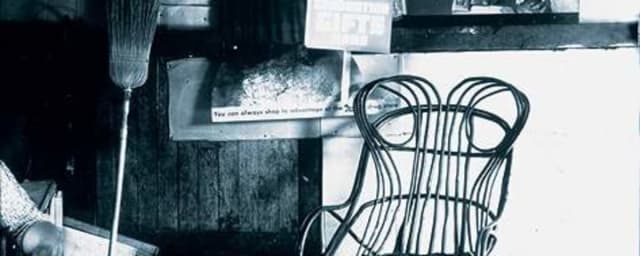
American social realist photography
American social realist photography consists of images documenting rural poverty and human hardship during the Great Depression in America in the 1930s and 1940s. Its most powerful body of work emerged within the government programme of the Farm Security Administration (FSA), which hired photographers to record the effects of economic crisis and drought on small farmers and migrant labourers. Key figures include Dorothea Lange, whose Migrant Mother (1936) became an iconic image of the era, along with Walker Evans, Gordon Parks, Arthur Rothstein and Ben Shahn. These photographers sought not only aesthetic quality but social impact: their images shaped public opinion and supported New Deal reforms. The combination of documentary precision with compassion for the individual made this tradition a model of responsible photojournalism. Its principles, to bear witness to injustice and give voice to the dispossessed, remain relevant to documentarians around the world, including in Ukraine.
Read more →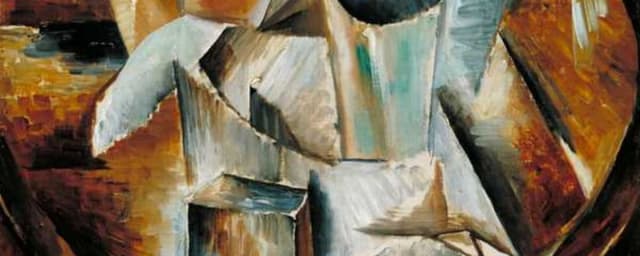
Analytical cubism
Analytical Cubism is the early phase of Cubism, usually dated to roughly 1908 to 1912. It is characterised by the fragmented appearance of objects shown simultaneously from multiple viewpoints and by a system of overlapping planes that break volume into facets. Instead of depicting the world from a single fixed position, the artists analysed form, broke it into components and redistributed them across the surface of the canvas, combining different angles in one image. The approach was developed by Pablo Picasso and Georges Braque in close creative collaboration in Paris. Their canvases of this period are distinguished by a restrained, almost monochrome palette of ochres, greys and browns, so that attention is not drawn away from the complex structure of the form. Favoured subjects were portraits and still lifes with musical instruments, bottles and newspapers. Analytical Cubism radically rethought the foundations of Western painting since the Renaissance by abandoning illusionistic perspective, and it prepared the transition to Synthetic Cubism, in which collage and brighter colours appeared. It had an enormous influence on the entire later development of modernist art.
Read more →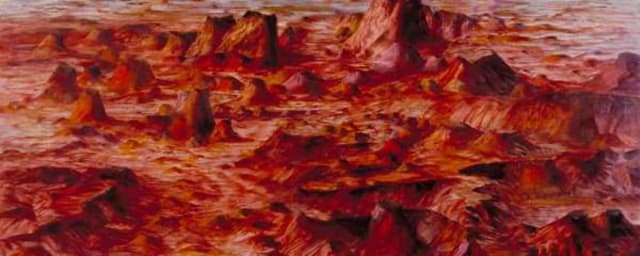
Angry Penguins
Angry Penguins was a modernist literary and artistic movement that sought to shake up Australia's entrenched cultural elite in the 1940s. The name came from an avant-garde journal of the same title published by the young poet Max Harris, and the movement centred on the circle around the collectors and patrons John and Sunday Reed near Melbourne. Some of the most important Australian artists of the century were associated with it—Sidney Nolan, Albert Tucker, Arthur Boyd, and Joy Hester—who fused European Expressionism and Surrealism with an acute sense of modern anxiety, war, and the Australian landscape. The best-known episode in the movement's history is the "Ern Malley" hoax of 1944, when two conservative poets invented a fictitious author and sent Harris pseudo-modernist verse to ridicule the avant-garde; the scandal damaged the journal but paradoxically cemented the legendary status of Angry Penguins in the history of Australian modernism.
Read more →Animal painting
A genre of art whose principal subject is the animal; more broadly, animalistics is any depiction of animals in art.
Read more →
Animation
Animation is the technique of creating the illusion of movement through the rapid, sequential display of a series of static images, each differing slightly from the last. The human eye perceives these separate frames as continuous motion owing to the characteristics of visual perception. The history of animation goes back to the optical toys of the nineteenth century — the thaumatrope, phenakistoscope and zoetrope — while the first fully fledged animated films appeared in the early twentieth century thanks to pioneers such as Émile Cohl, Winsor McCay and Walt Disney. There are many techniques of animation: traditional hand-drawn (frame-by-frame) animation, puppet and clay stop-motion, cut-outs, and, from the late twentieth century, computer 2D and 3D animation. In an artistic context, animation is used not only in commercial cinema but also as a means of personal and experimental expression: animator-artists such as Jan Švankmajer, Norman McLaren and William Kentridge turn the movement of images into an independent visual language. Ukraine has a strong school of animation associated with the Kyivnaukfilm studio and the names of Volodymyr Dakhno (the Cossacks series) and David Cherkassky. Today animation is an important component of contemporary art, video art and digital media.
Read more →
Anthropophagia
Anthropophagia literally means cannibalism, the eating of a human being, but as an artistic term it is associated above all with Brazilian modernism. The concept derives from the Cannibalist Manifesto (Manifesto Antropófago) published by the writer Oswald de Andrade in 1928. The metaphor of cultural cannibalism proposed a strategy by which Brazilian culture should devour European influences, absorb them and transform them into something new and distinctive rather than passively copying colonial models. The idea drew on the image of indigenous peoples who ritually ate an enemy in order to take on his strength. In art it was vividly embodied by the painter Tarsila do Amaral, notably in the painting Abaporu (1928), which inspired the manifesto itself. Later, in the 1960s, anthropophagia became the conceptual basis of the Tropicália movement, which spanned music, film and the visual arts; its representatives, though rooted in Brazil, deliberately drew influences from Europe and America, digesting them into a hybrid national form. Anthropophagia remains an influential concept in postcolonial theory about cultural identity and appropriation.
Read more →
Antiquity
The Classical Antiquity of the Northern Black Sea (800 BCE–476 CE) spans more than a millennium of Greek and later Roman presence across what is now Ukraine's south. Beginning in the seventh and sixth centuries BCE, settlers from Miletus, Heraclea and other city-states founded colonies that became outposts of high Mediterranean culture: Olbia at the mouth of the Southern Buh, Tyras on the Dniester, Chersonesus near modern Sevastopol, and Panticapaeum — capital of the Bosporan Kingdom — on the site of Kerch. These cities featured regular planning, temples, theatres, agoras, defensive walls and their own minted coinage. The art of the age is represented by marble and terracotta sculpture, painted and black-glaze pottery, jewellery, funerary stelae and mosaics, as well as the fresco painting of Bosporan burial vaults. Chersonesus preserved a unique stone-inscribed "citizens' oath" and a grid of streets still legible on the excavation site. Through these poleis Greek artistic forms reached the steppe peoples, while the grain, fish and slaves of the Pontic region flowed to Hellas. In the first centuries CE the region entered Rome's sphere of influence, which garrisoned troops here. The decline of the antique cities is bound to the incursions of Goths and Huns in the third and fourth centuries and the general crisis of late antiquity, symbolically closed by the year 476. The Pontic classical heritage is the oldest stratum of urban civilisation on Ukrainian lands.
Read more →
Art Nouveau
Art Nouveau is an international style of the turn of the nineteenth and twentieth centuries that sought to renew art by uniting painting, graphics, architecture and applied design into a single artistic ensemble. Its core is the cult of natural, organic form: the sinuous "whiplash" line, plant shoots, flowers, stems, waves of hair and elongated female figures. Art Nouveau artists deliberately avoided the right angle and symmetry, favoring a flowing asymmetrical rhythm, decorative flatness and refined color schemes of muted, pastel tones combined with gold. The style made active use of new materials — wrought iron, glass, ceramics — and of the lithographic poster, which made art part of the urban environment. In different countries it bore its own names: Secession in Vienna, Jugendstil in Germany, Stile Liberty in Italy. Its emblematic figures are Alphonse Mucha with his posters and decorative panels, Gustav Klimt with his mosaic-like ornament, and the architect Victor Horta. In Ukraine Art Nouveau found vivid expression in the architecture of Vladyslav Horodetsky in Kyiv and in the work of masters connected with folk ornament, notably in the graphics of Heorhiy Narbut, who fused European Art Nouveau with the Ukrainian tradition. Art Nouveau was the last great unified style to embrace every sphere of visual culture and, at the same time, prepared the ground for the avant-garde experiments of the early twentieth century.
Read more →Assemblage
A technique of making a three-dimensional work by combining disparate elements, above all found or ready-made objects; also the resulting work.
Read more →
Avant-garde
The avant-garde is not a single style but a broad movement of radical artistic renewal in the first third of the twentieth century that broke with academic tradition and proclaimed the artist's right to complete freedom of form and experiment. The term itself, borrowed from military vocabulary, means "advance guard": the avant-gardists saw themselves as heralds of a new vision, called to demolish habitual visual norms. The shared features of the avant-garde currents — Futurism, Cubo-Futurism, Suprematism, Constructivism, Dadaism — are the deformation or complete rejection of objecthood, the analysis of form, the cult of dynamism, the machine and the city, and a programmatic, manifesto-driven character. Artists actively introduced collage, montage, non-objective composition, sharp color contrasts and new materials. The Ukrainian avant-garde of the 1910s to 1930s became one of the movement's most powerful centers: Kazimir Malevich created Suprematism, Oleksandr Bohomazov developed a theory of "dynamic" pictorial form in his treatise Painting and Elements, Alexandra Exter fused Cubism with vivid colorism, while Vasyl Yermilov and Vadym Meller worked at the border of Constructivism and stage design. David Burliuk and the Boychukist school worked alongside them; most of the Boychukists were killed by the Stalinist regime and are counted among the "Executed Renaissance" generation of the 1920s–1930s. The avant-garde fundamentally changed the language of twentieth-century art, laying the foundations of abstraction, design and conceptual practice.
Read more →



